

For India to fulfill its growth potential, it is imperative that the country achieves self-sufficiency in edible oil and slashes its reliance on imports. The “From Field to Fortune” report, published by Solidaridad and The Solvent Extractors’ Association of India, presents a clear roadmap for transforming Odisha into a leading contributor to India’s vegetable oil security.
The challenge is a steep one. Domestic production of oilseeds meets only 44% of the demand, and there is a significant reliance on imports. The demand–supply gap is expected to reach 14.1 million tonnes by 2030. Moreover, traditional oilseed hubs such as Gujarat and Maharashtra are oversaturated in terms of land under edible oil cultivation, highlighting the need to identify more regions in India that can spearhead oilseed production.
With 1.17 million hectares of unused rice-growing land and 10 distinct agro-climatic zones that are conducive to the cultivation of a variety of oilseeds, Odisha has strong potential to be the next frontier of oilseed cultivation. Its strategic location along the eastern economic corridor also provides proximity to major consumption centres such as Kolkata, Chennai and Visakhapatnam, as well as export markets including Bangladesh. This makes Odisha an attractive destination for both domestic processors and export-oriented units.
The report, “From Field to Fortune: A Strategic Roadmap for Oilseed Production in Odisha,” demonstrates a strong case for Odisha to emerge as a frontier oilseed hub in India. It was recently launched at the platform of The National Alliance for Regenerative Vegetable Oil Sector (NARVOS), a joint initiative of Solidaridad Asia and The Solvent Extractors’ Association of India, at a state-level event in Bhubaneswar.
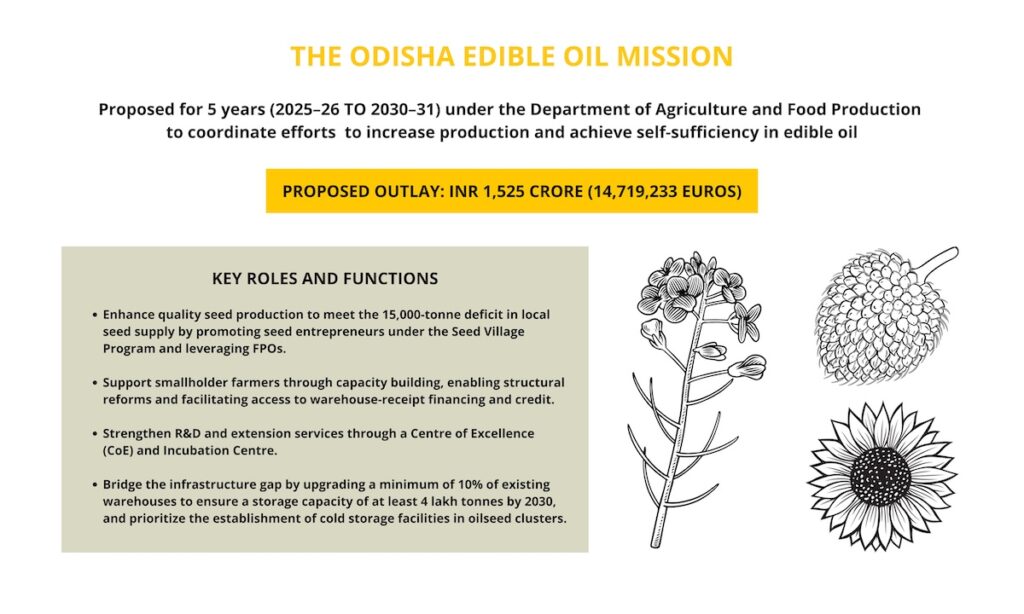
Odisha has the potential to produce an additional 3.56 million tonnes of oilseeds by 2030, contributing an additional 770k tonnes of edible oil to help meet 5.4% of India’s edible oil demand–supply gap. However, to transform the state into an oilseed production hub, the report proposes a focused and multidimensional strategy, bundled as the Odisha Edible Oil Mission, for a period of five years.
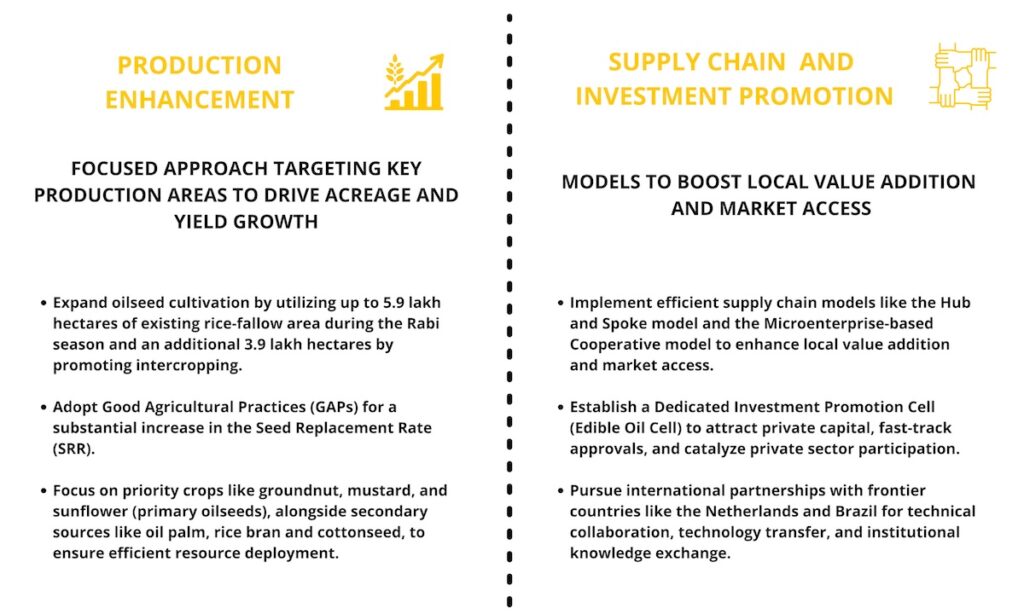
Other key elements of the proposed growth strategy include production enhancement and the promotion of supply chains and investment.
Gains for Odisha
- INCREASING FARMER INCOME: Cultivating oilseed crops offers returns of up to 2.3 times the investment, compared to a return of 1.7 times from traditional crops like rice grown in paddy fields. Hence, on average, farmer income could double by intercropping and cultivating oilseeds in rice fallow areas, increasing it from INR 60,000 (~570 euros) to INR 121,000–185,000 (~1155-1765 euros). This represents an increase of 101% to 209%, depending on the oilseed crop.
- STIMULATING STATE ECONOMY: The government investment of INR 1,525 crore (145.5 million euros) is anticipated to catalyze additional private investments and stimulate the state’s economy through backward and forward linkages. This is projected to generate an output impact of approximately INR 49,410 crore (~ 4.72 million euros) over a period of five years, resulting in 32 times the initial investment. This would contribute an additional 0.2–1.3% to Odisha’s Gross State Domestic Product annually. Additionally, the processing plants are expected to generate around INR 6,770 crore (~650 million euros) in revenue for the state over their 15-year lifecycle, yielding a return that is 4.4 times the initial investment.
- BOOSTING LOCAL EMPLOYMENT: Expanding oilseed cultivation and edible oil processing will significantly boost local employment, generating an additional 36.3 million workdays in the farm sector and 80k workdays in the processing sector per annum, over a period of five years.
- REDUCING IMPORT DEPENDENCY: Expanding oilseed cultivation and improving yields could lead to an additional .77 million tonnes of edible oil production by 2030, helping bridge approximately 5.4% of the projected national edible oil demand-supply gap by 2030.
- IMPROVING NUTRITIONAL OUTCOMES: Diversification into oilseed crops can significantly improve nutritional outcomes of agricultural households, as well as people at the bottom of the pyramid, through increased income and affordable access to edible oil.
- BENEFITING THE ENVIRONMENT: Expanding oilseed cultivation will help increase cropping intensity, enhance soil quality, reduce water use and lead to a shift away from monocropping, helping in long-term sustainability and meeting the government’s objective of increased cropping intensity and crop diversification.