

Through Solidaridad’s SEF project, more than 1,700 unemployed young people are currently engaged in work-based learning across agricultural value chains. On active farms and food gardens, participants gain hands-on experience in soil preparation, crop maintenance, pest and disease management, irrigation, record-keeping and enterprise development. Learning is guided by experienced farmers and Solidaridad technical staff, ensuring that skills are rooted in real production and real livelihoods.
Learning by Doing: Education That Connects Knowledge to Purpose
South Africa’s youth unemployment rate (ages 15-34) has persistently hovered between 40% and 50%, significantly higher than the national average. For many young people, access to meaningful education and work experience remains deeply unequal.
“We need to start by acknowledging the context,” says Sade Balogun, Programme Manager at Solidaridad. “Most SEF participants are unemployed youth who have been locked out of both education and work.”
She explains that learning on farms helps reconnect knowledge with purpose. “Participants don’t just acquire technical farming skills. They learn communication, teamwork, planning and responsibility. This learning is tied directly to real production and real outcomes, which is what makes it transformative.”
Through this program, education is practical, dignified and socially useful. Participants are paid a stipend that provides stability while they contribute to food production that meets real community needs.
From Setback to Strength: A Farmer’s Journey Through SEF
For Tonic Moshobane, the SEF journey was marked by both hardship and resilience.

“Our seeds were stolen from us. I picked up what was left over and used those seeds to start farming,” she recalls. “After graduating as an SEF participant at Rayon Integrated Farm, we tried to farm as a cohort. But in December 2024, our seeds, water tank and pressure pumps were stolen. The group felt completely discouraged and everyone left. I was left to farm alone.”
But she persevered. Using whatever seeds remained, she farmed over a hectare by hand.
“I was farming on my hands and knees. I cried out to Solidaridad, and instead of being left alone, I was encouraged. They continued supporting me with technical skills, advice and mentorship. That support kept me going when I wanted to give up,” she shared.
“When a local farming competition opened,” continued Tonic, “Solidaridad staff member Dumisani Ngonyama helped me prepare. Winning changed everything. Solidaridad and SEF still stood by me. They even surprised me by placing 10 SEF participants on my farm. That meant additional labor, learning and dignity not just for me, but for others too”
Despite major setbacks, the skills and mentorship she gained through SEF helped her to register her own farm in January 2025. By March 2025, she was harvesting spinach and selling to her local community, strengthening household food security. Today, she hosts 10 SEF participants herself, plants over 7,000 seedlings of spinach and has become a facilitator of learning for other unemployed youth within her community.
“The stipend helped me survive when I was financially unstable. I was broke, broke, broke,” she says. “But the real change came from skills transfer, mentorship and continued support. Even after I graduated, SEF did not leave me.”
Growing Skills, Markets and Food Systems
Another former SEF participant, Lethlogonolo Mnguni, now farms at scale. A postgraduate in Crop Science from Tshwane University of Technology, he leases approximately 8 hectares of land and, at peak production, has planted over 100,000 heads of cabbage, alongside spinach and tomatoes.
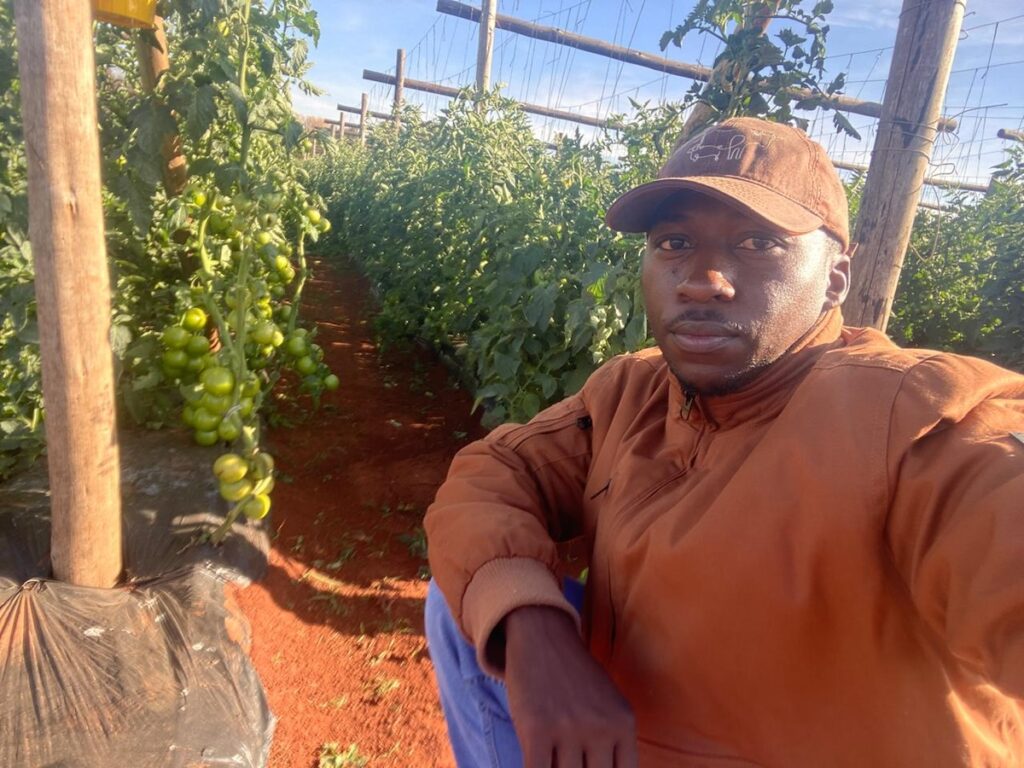
“SEF taught me to be detailed… from understanding seed quality and soil preparation to identifying markets and managing time,” Mnguni explains. “The stipend was never my main motivation. I joined SEF to gain skills, mentorship and the discipline required to succeed in farming,” says Mnguni.
Mnguni supplies produce to the Johannesburg Market and retailers such as Spar, and credits continued SEF mentorship for his growth. “Even now, Dumisani Ngonyama, my mentor from Solidaridad, still comes to my farm, even on weekends, to advise on land preparation, fertilizer programme, pest and diseases schedule, planting schedules and crop planning. That ongoing support is rare, and it has been life-changing.”
According to Dumisani Ngonyama, SEF Project Coordinator at Solidaridad, learning on farms is what makes social employment effective. He believes that the SEF programme can truly usher in change that matters.
“It’s not enough to teach people how to grow crops. We help SEF participants work together, pool produce and access markets. Some participants now supply retailers like Pick n Pay by collaborating across various smallholder farms. This is how social employment strengthens food systems, not just individuals,” he states.
Beyond income and skills, SEF delivers social value. Participants contribute food to households, schools and communities. Farmers benefit from labor and become mentors. Youth move from exclusion to participation and building confidence, dignity and pathways into employment, self-employment, or enterprise.
“Like seedlings production,” Ngonyama reflects, “it gives me real joy to watch participants grow and bear fruit. The Social Employment Fund, in partnership with Solidaridad, is truly rooted in changing the lives of youth in South Africa. I see it every day.”