

More than 2,000 representatives from producer and industry organisations in Argentina, Brazil, Paraguay and Uruguay, as well as representatives of the European Commission, participated in more than 50 national events, as well as two regional events at the Mercosur level, between February 2024 and January 2026.
The main objective of the meetings, coordinated by Solidaridad, was to bring the discussion of the EUDR and CSDDD frameworks to various types of producers, including small-scale farmers. This shift allowed us to focus more closely on producers’ main technical concerns, and to promote solutions to demonstrate compliance with deforestation-free production requirements and with each country’s legal framework. In Paraguay, it improved communication between the main soy guilds and producers working on traceability.
To provide continuous support in the transition toward EUDR compliance, the project integrated the discussion into existing dialogue spaces. National chapters of the Round Table for Responsible Beef in Uruguay (MUCS), Brazil (MBPS) and Argentina (MACS), and regional networks were strengthened to promote solution-oriented dialogue.

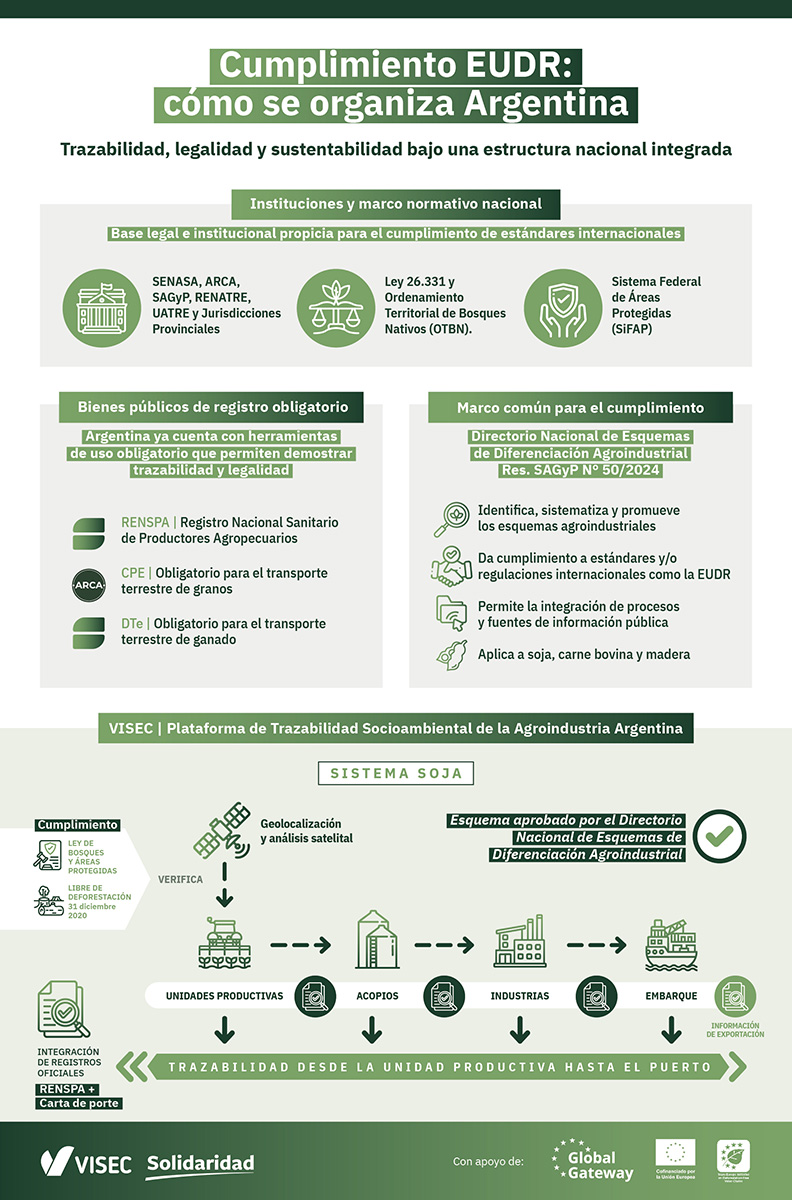
Together, these actions strengthened collaboration between the private and public sectors to support traceability platforms such as RETSA (public) in Paraguay, and VISEC (private) in Argentina. They also contributed to the two overarching goals: continuing to promote sustainable and deforestation-free production, and fostering the participation of Mercosur producers in the European market.
“The initiative showed that adapting supply chains requires coordination, transparency and solutions tailored to local realities. In this sense, we were able to strengthen spaces for technical exchange and collaboration between producers, companies, governments and civil society to support a just and inclusive transition,” argues Rodrigo Castro, Solidaridad’s Country Manager in Brazil.
Dialogue focused on practical solutions
As mentioned above, the dialogues centered on producers’ main concerns in both sectors:
1) Clarifying the scope and market implications of the regulation, particularly in relation to traceability. According to industry representatives, the region is making progress in developing technical traceability systems and integrating them with existing national platforms. There is also progress in encrypting producer data. However, doubts remain about the interoperability between regional interfaces and European systems.
2) Identifying the main gaps that limit an effective application of the regulation. There has been general agreement on the need to develop remediation measures aimed at installing the required infrastructure for traceability systems, with special attention to small and medium-scale producers who face greater barriers to meet these requirements.
3) Identifying and sharing effective adaptation practices to comply with EUDR among producers and stakeholders from different countries to support the transition of supply chains.
4) Improving communication between producers and the European Commission.
As a result, Solidaridad and Proforest teams, together with national initiatives such as VISEC in Argentina and MUCS Uruguay, and programs such as AL-Invest Verde, the Argentine-German Dialogue on Sustainable Agricultural Innovations and the Zero Deforestation Project, compiled the following free guides and analyses:
- Traceability and Transparency in Mercosur: EUDR-readiness in the beef supply chain (ENG)
- Instruments in MERCOSUR countries to support EUDR compliance in Beef Supply Chains (ENG)
- Lessons learned from pilot shipment to comply with the EUDR (SPA)
- Frequently Asked Questions Guide about EUDR in Argentina (SPA)
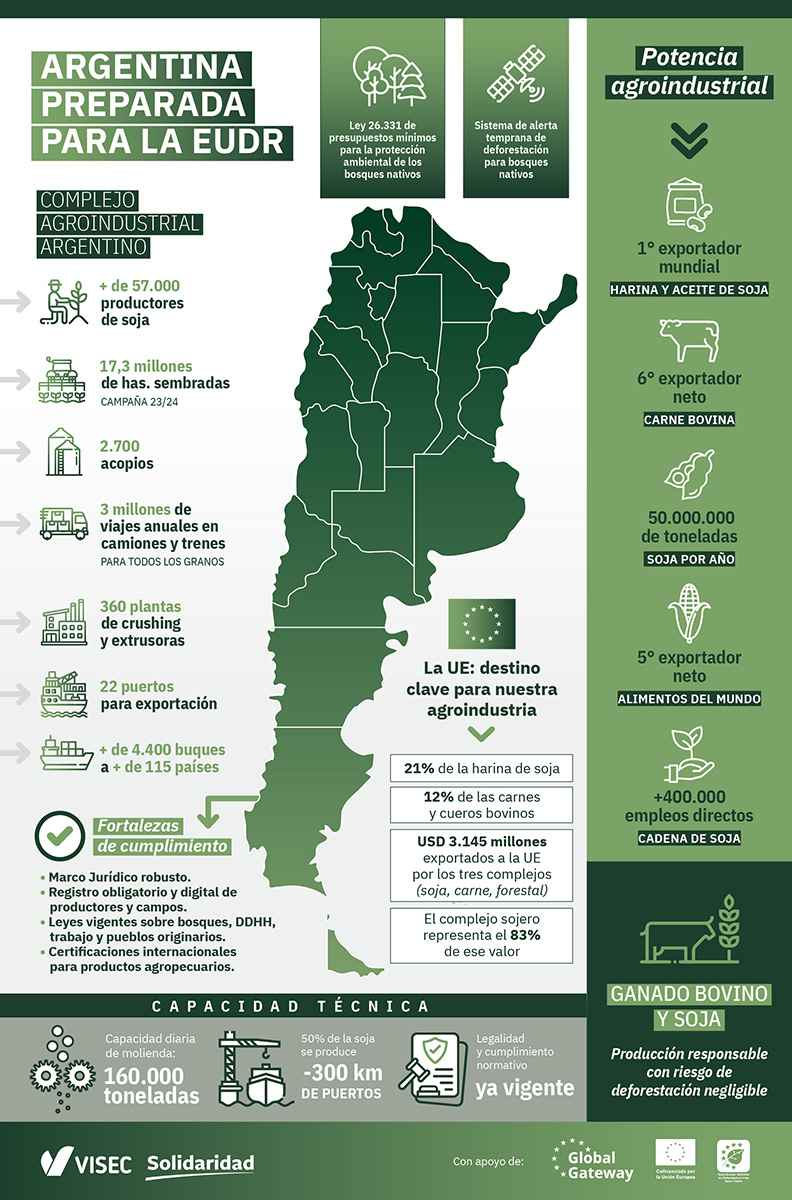
- EUDR compliance; how Argentina is organized (infographics, SPA)
- Frequently Asked Questions Guide about EUDR in Brazil (PT)
- Exporters from Brazil and EUDR: Beef and Soy dry runs. Traceability, Monitoring and Transparency in the Beef and Soy Supply Chains in Brazil. (ENG, PT)
- Potential for expanding soybean production in compliance with the EUDR in the Matopiba (PT)
- Livestock farming without deforestation: Uruguay’s situation in relation to the EUDR (SPA)
- Analysis of the progress of the main regional initiatives with direct or indirect intervention of national governments as of May 2025 (SPA):
- Argentina: VISEC/ Tracestory
- Bolivia: Bolivian Soybean Traceability Platform
- Brazil: Sustainable Agriculture, Green Seal
- Paraguay: RETSA, SISE
- Uruguay: Certification System for Agricultural Export Products
Conclusions and recommendations
“With this initiative we accomplished the goal to reach the largest number of producers with up-to-date, reliable and relevant information, as well as give them the opportunity to engage in direct dialogue with representatives of the European Commission” – Milagros Menna, Country Lead of Solidaridad in Argentina.
The audience’s response showed that these spaces for dialogue and joint work help producers to become better informed, raise their concerns and better understand the regulatory changes being discussed, as well as their possible implications for production.

“The dialogues reinforced the idea that the EUDR can be seen as an opportunity for Brazilian livestock farming to advance in efficiency, management and market access. Traceability is a central pillar of this process, provided it is built in an integrated and inclusive manner, with clear communication, technical assistance and support for producers, especially small and medium-sized ones,” stated Michelle Borges, executive manager and representative of the Brazilian Roundtable for Sustainable Livestock, at one of the events.
The main recommendation arising from the meetings is to continue promoting these initiatives, focusing on small and medium-sized producers. They still need to strengthen their understanding of the scope and implications of the EUDR, as well as receive technical support and financial incentives to ensure a fair transition without facing disproportionate costs or administrative burdens. In this sense, the project has laid the foundations for generating spaces for dialogue as useful tools and now the value chain actors (VISEC, MUCS, MBCS) are giving it continuity to promote the inclusion of producers in EUDR.